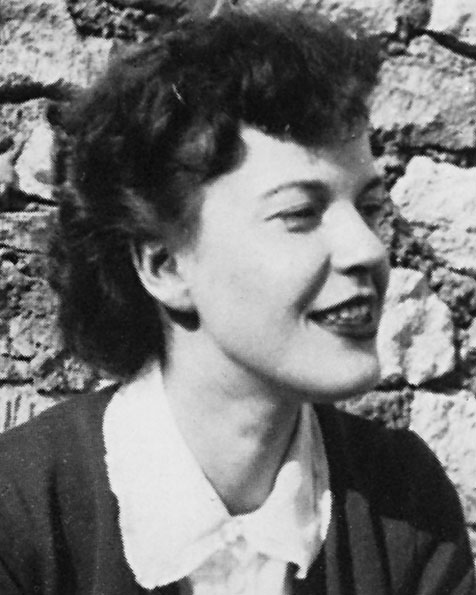
Ingeborg Bachmann was a poetess, an intellectual, a politically engaged author and an active and radiant member of Group 47. She had a profound impact on the German-speaking literary scene after 1945. She excelled in the subtle analysis of female subjectivity, of social gender relations between desire and destruction, and revealed the durability of fascinating thought, detected in the daily relations between man and woman. Her childhood was marked by the experience of war, Nazism, borders and the narrow universe of the provinces. She was a humanist who lived in pacifist exile, successively in various European cities including Rome, where she ended her recluse life and died from injuries caused by her apartment fire. She wrote poems, radio plays, stories, novels, philosophical essays, opera libretti (with her friend Hans Werner Henze, a composer). She held the first chair of poetology in Frankfurt in 1959-1960 (“Frankfurter Vorlesungen”, [Frankfurt Lessons]). She met the great thinkers and authors of her time, forged a passionate and artistic relationship with Paul Celan, and then led a life of conflict with Max Frisch (1958-1962). She received the Georg Büchner Prize in 1964. Her dazzling career, from 1952 onwards, delighted critics who acclaimed her two great collections “Die Gestundete Zeit” ([Suspended Time], 1953) and “Anrufung des Grossen Bären” ([Invocation of the Great Bear], 1956). But German-speaking literature seemed to be insensitive to the author’s acidic and critical view of the “restorative” tendencies of her time. I. Bachmann defended poetics of vigilance. The poet as a sort of outpost must resist sleep, the attempt to forget, the illusions. A new language, both tangible and abstract, is invented, carrying wounds, making us visible and tending towards a better world. In the 1960s, I. Bachmann stopped writing poetry, referring to its dead ends and ploys (“Keine Delikatessen”, [No Delicacies], 1963). She continued her questions in prose, combining poetic language and philosophical reflection on the relationship between language, truth and love and on the plurality of value systems. The issue of gender difference was accentuating, as she wondered about her status as a woman author in “Undine Goes” in her collection “The Thirtieth Year” (1961). Critics were reluctant to accept this woman’s political and intellectual commitment and denounce in “Three Paths to the Lake” (1972) miserable portraits of neurotic, hysterical and frustrated women. Feminist critics rejected them just as much, as they do not constitute positive role models. It was only in the 1980s that her prose was reinterpreted, considering the strategies of subversive mimesis and the deconstruction of her subtle, polyphonic and ironic writing. Her trilogy on “ways of dying” is her greatest work (“Todesarten/The Book of Franza & Requiem for Fanny Goldmann”), with the major thesis that people, in this society, do not die, rather they are murdered. In “The Book of Franza, Requiem for Fanny Goldmann” and “Malina” (1971), her only completed novel, she explores the mechanisms of exclusion, colonisation and destruction of femaleness and everything else in its relationship to man, in the symbolic order, in artistic production. “Malina” became a cult feminist novel, brought to screen by Werner Schroeter (1991). I. Bachmann recounts the murder of a woman in a symbolic and patriarchal order. It refers to the ambivalence of desire in which the female subject traps, appropriates and alienates herself. But her entire work can be understood as an engaged and aesthetic struggle exploring the boundary between the happy alteration of the subject crossed by the other and annihilation.