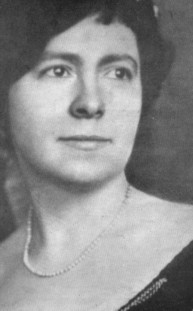
Born into a family of intellectuals, Mária Berde was the most prominent embodiment of Hungarian-language literature in Transylvania between the two world wars. After studying Hungarian and German at the University of Kolozsvár, she published her first poem collection in 1912, still marked by the patriotic and populist movement, but already raising the issue of equality between women and men. She also devoted her doctoral thesis to the work of a woman, Austrian poet Gabriella Baumberg. In 1912, a year she spent in Munich, she begun her impressionist novel “Az örök film” ([Eternal Film], 1917), where a mosaic of atmospheres evokes the student life of the city and one of the characters was inspired by Rilke. “Haláltánc” ([Danse Macabre], 1924), marked by Jugendstil aesthetics, refers to the experiences of her cure in a Swiss sanatorium which lasted nearly a year. Her works bear witness to deep Calvinist faith and generous humanism, hostile to the rise of fascism and xenophobia. Berde, a feminist, whose novel “Szent szégyen” ([Sacred Shame], 1925) recounts the life of a single mother, was convinced that the disappearance of social prejudices would put an end to women’s subjection and lead to symmetrical relationships between the two sexes. If her collection “Seherezádé himnusza” (“Scheherazade’s hymn”, 1928) is that of poetic maturity, her last book, “A hajnal emberei “([The Men of Dawn], 1943), where the action takes place in nineteenth century Transylvania and which was not published in complete edition until 1995, is the pinnacle of her romantic work. She was a high school teacher and editor for various periodicals and has also translated Romanian and German poets into Hungarian.