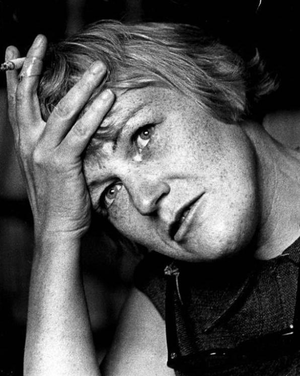
Because she was from a modest family, Sonja Åkesson had to stop school early. Divorced, remarried and the mother of three children, she started her poetry career aged 30, but only acquired notoriety a few years later with her poetry collection “Husfrid” ([Domestic Peace], 1963) ‒ particularly with “Självbiografi” [Autobiography], a reaction to Lawrence Ferlinghetti’s “Autobiography”, a Beat Generation poem, and with “Äktenskapsfrågan” [The Matrimonial Issue], which ironically tackles the fixed roles attributed to both sexes. A feminist, she staged housewife characters who despite material prosperity suffer from anxiety and lack self-confidence. In the collage collection “Pris” ([Price], 1968), she denounces the superficiality of the world view of the press. She also published in collaboration with her husband “Strålande dikter/Nej så fan heller” ([Brilliant Poems/Hell No], 1967). She wrote “Sagan om Siv” ([Siv’s Saga], 1974) in Japanese haiku form. Irony is one of her most efficient means of action, with titles such as “Ute skiner solen” ([The Sun is Out], 1965), “Man får vara glad och tacka Gud” ([We Should Be Happy and Thanfkul to God], 1967) and “Ljuva sextiotal” ([The Sweet Sixties], 1970). In her poetry, common human life is sometimes described in terms of cannibalism, but to the intransigent judgement of one succeeds the empathy of the other. The stiffness of being stationed in self-justification is eased by humour, since the author, despite her suspicion towards language, believes in the possibilities of communication. Her criticism of the Swedish welfare state, of commercialisation and advertising, as well as the problematisation of female and male behaviour is still relevant. Especially renowned as a poet, she has also written in prose, for the theatre and cabaret, as well as for the Swedish press.