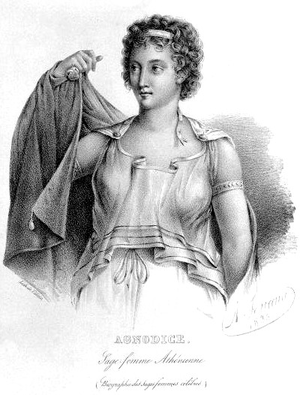
In ancient Greece, before the fifth century, women were not allowed to practise medicine and they delivered by relatives or neighbours. Those who were particularly skilled, the maia or midwives; had knowledge and experience, not only about childbirth, but also about all female illnesses. This tradition disappeared at the end of the fifth century when gynaecology was taken over exclusively by men, apparently because of their concern about their fatherhood. We don’t know much about Agnodice’s life. Most of the information comes from first century Latin author Hyginus. Legend has it that, in order to study medicine with Herophile, the famous Alexandrian doctor, Agnodice cut her hair and wore men’s clothes. Once she finished her studies, as she was helping a woman give birth, the latter refused, thinking she was dealing with a man. Agnodice then lifted her dress, to show that she was a woman, and was accepted. She ended up being revered, women even pretending to be ill, it is said, to receive her care. She became a victim of her own success and attracted the jealousy of her colleagues, then had to face a trial where she revealed her identity and risked death penalty. The magistrates finally acquitted her, faced with the rise of women’s protests. The following year, the Athenian council authorised the study and practice of medicine for women. According to “Antiqua Medicina”, Hyginus’ story is unlikely to be based on real facts. It is possible that Agnodice was a resurgence of the myth of Baubo, of which there are many representations on terra cotta. These figurines represent a woman with a figure painted on her belly, who rolls her skirts over her head while dancing, in order to amuse Demeter, the Greek goddess of fertility, by showing her genitals to her. Despite doubts about her existence, she remains history’s first female gynaecologist.