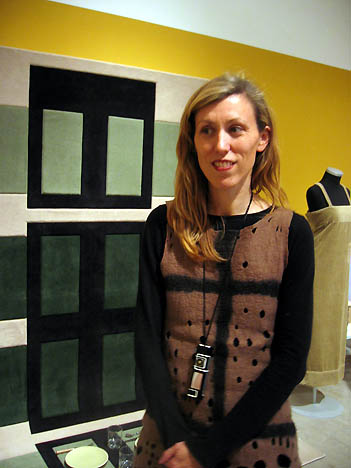
Andrea Zittel graduated with a Bachelor of Fine Arts in Painting and Sculpture from the University of San Diego, followed by a Master of Fine Arts in sculpture from the Rhode Island School of Design. In the early 1990s, she created her first Living Units, experimental housing units sporting a minimal and geometric design which, in their compact format, contain everything needed to live: a bathroom, bed, kitchen are thus fitted into a transportable and foldable wooden box – the dominant raw material. Influenced by modern design and contemporary architecture, in 1992 she established A-Z Enterprise, which produced custom supplies, housing, and vehicles, personalized according to her clients' personalities. The company was located in New York, in a house which acted as a space used for living, manufacturing, and exchanging; in 2000, she relocated the project to the middle of the California desert, where a community of artists have been put to work. In the tradition of land art and creators such as Walter De Maria, A. Zittel is actually directing the The High Desert Test Sites, a series of experimental art sites. Blurring the line between art and life, she extended her area of inquiry to include her own lifestyle: dwelling, food, and clothing (dresses with clean lines, made of natural materials, which she wears for an entire season). By doing so, she constantly reinvents her relationship with the domestic environment, tackling natural and fundamental human needs. The functional and the practical take precedence over design. She also created A-Z Escape Vehicles, which are somewhat like small caravans that can accommodate one or two people, accessible through a hatch in the roof, and whose interiors are decorated with a rocky landscape made out fibreglass or a comfortable padded living room. Her work, fundamentally participatory and environmentally conscious, takes into account the human body and its dimensions, needs, and desires. Her process is based on the requirement to live in the most enjoyable conditions, in harmony with the natural environment and in a self-sufficient manner. A. Zittel also produces paintings that are related to her other works. Her most significant projects include the Non-Manhattan Project, deployed in 1999 in Central Park. In 2008, the Schaulager in Basel featured her in a monographic exhibition.
Mélanie HAMET