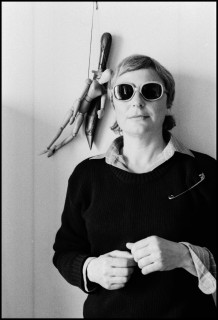
Gina Pane was a major figure of the body art movement in the 1970s. She moved to Paris in 1961, where she would study at the École Nationale Supérieure des Beaux-Arts and the Ateliers d’Art Sacré. Her first paintings, marked by geometric abstraction and Russian constructivism, gave way to the creation of penetrable sculptures that allowed her to invite spectators to experience her own body. In a similar manner as GRAV (Groupe de Recherche d’Art Visuel) and Brazilian artists such as Hélio Oiticica and Lygia Clark*, but also and especially Merce Cunningham and John Cage, she experimented with this "new relationship to art," : a breaking down of barriers between disciplines that she found in the work of Black Mountain College artists. In the late 1960s, nature, which she perceived as a "poetic force" and "a locus of memory and energies," became the arena of her artistic, environmental, and political engagement. To G. Pane, it is the artist's actions that matter. The names of her works already point towards this attitude: Pierres déplacées (Displaced Stones, 1968), Enfoncement d’un rayon de soleil (Burial of a Ray of Sunlight, 1969), Continuation d’un chemin de bois ou Semences de graines de chanvre (Continuation of a Wooden Railroad or Sowing Hemp Seeds, 1970). In Situation idéale, terre-artiste-ciel (Ideal Situation: Earth-Artist-Heaven,1969), documented, as always by a photograph taken on location, we see the artist, standing, at the top of a ploughed field on a slope, between heaven and earth, with her hands in her pockets. This action acquires symbolic value: G. Pane occupies the privileged position of mediator, the ferrywoman between heaven and earth, sensitive and intelligible, material and spiritual. In the early 1970s, her body itself became the material used in her work, and often led her to put herself at risk. First carried out without a public, in her workshop, then in private apartments or various institutional spaces, these "actions" examined her personal obsessions, while also raising sociological and political questions. In Escalade non anesthésiée (Unanesthetized Escalation, 1971), the barefoot and bare-handed artist scales metal steps covered with sharp spikes, as a reference to the steps that we are required to climb to reach a social "position", as well as the escalation of the American intervention in the Vietnam War. Experiences at the limit of what can be endured – eating a plate of raw meat for one hour and fifteen minutes, in Nourriture (Food, 1971) – alternate with more intimate actions that refer back to childhood (brushing her belly with feathers, playing with a ball) or to the feminine condition, as in her famous Azione Sentimentale (Sentimental Action, 1973). At the Diagramma gallery in Milan, in front of an exclusively female public, she ritualizes a symbolic act of self-mutilation in a rather extreme manner: dressed in white, she slowly sticks the thorns of a bouquet of red and white roses into her arms, and while moving progressively from a standing to foetal position, she makes incisions in the palm of her hands with a razor blade. The sacrificial dimension of these actions evokes the mysticism of the martyr, but also the female gender and menstrual blood. The creation of a performance workshop at the Centre George-Pompidou in 1978 marks the apex and the end of G. Pane's performance-based art. Following a final action in 1979, in New York, she begins her "notation" period, halfway between installation and sculpture, where the wounds and experiences her body endured are symbolically transferred to matter (broken glass, rusty steel, wood, copper) and allows the spectator to imagine many possible symbolic narratives. Starting in 1984, the retelling of the stories of the Saints and Martyrs in Légende dorée lends her "notations" a Christian suffering symbolism, where the body and the sacred intersect. Thus, her final work, La prière des pauvres et le corps des saints (The Prayer of the Poor and the Bodies of Saints, 1989 – 1990), is a monumental installation, where three reliquary displays, with body prints and symbolic elements, are dedicated to the Saints: Francis, Lawrence, and Sebastian. G. Pane also taught at the École des Beaux-Arts du Mans from 1975 to 1990.
Claire BERNARDI