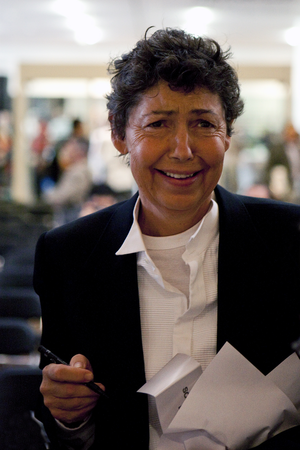
It took several decades before Isa Genzken's pieces (sculptures, installations, photographs, paintings, and collages) were recognized among some of the most important contributions to the history and renewal of sculpture. Composed of contemporary materials assembled in a sophisticated manner, her creations nonetheless display certain artisanal qualities. Her themes question relationships between private and public space, the autonomy of art, and the collective experience. From a socio-political point of view, her forms demonstrate how art can find a way to bring shape and life to thought, ideology, to humanity, its representations and disasters. The issue of material is of paramount importance to the artist. In the 1980s, she used wood, plaster, and especially concrete in her freestanding sculptures, which stand between 5 and 10 metres high and question the architecture that was then at the heart of the postmodern debate over "deconstruction." These conceptual objects are built following a rectangular design, enclosing space inside concrete walls without windows, fragments of architecture placed on a steel base (Marcel, 1987). In the 1990s, she introduced light and transparency: first using epoxy resin, a translucent material. She then started using coloured industrial glass, which give her pieces an ethereal aesthetic. The façade becomes her subject, as in the New Buildings for Berlin series (2001-2002), a fragile incarnation of the skyscraper, made of glass, erected and grouped according to triangular or rectangular designs. Then came, in the 2000s, the Social Façade series, where the artist employed a format normally associated with painting. Strips of the most diverse metals – from copper plates to aluminium sheets – are glued to rectangular frames. Light, refracted by prisms onto shimmering surfaces, mirrors and multiplies the observer's image, ego, and devastating power. This incursion took on even greater dimensions in the set of 22 sculptures entitled Empire Vampire, Who Kills Death (2002-2003), created following the September 11 attacks in 2001, which the visual artist experienced herself in New York. The materials became dirtier, and included plastic toys, debris; the colourless forms seem to be covered in ash, evoking the impenetrable and grey cloud that hung over the world that day. For a few years now, her installations have become more complex: recycled materials, bright colours, torn, decomposed images, providing a feeling of violence, a definitive break with the idea of art as an all-encompassing discourse. Her exhibition in the Chantal Crousel gallery in Paris in 2010 is a testament to this; she presented, namely, Mona Isa, which featured iconic characters from the history of art, such as Leonardo da Vinci, next to his own portraits, or Michael Jackson. In Hotel, Harfe, Ambulance, Nofretete, Bibliothek (2010), sculpture-bodies symbolize universal lifestyle, in Lautsprecher, empty speaker cabinets, receivers or transmitters suspended from the ceiling forever await sounds, and elephant, that big, sad, and tired animal enters the exhibition through a hidden window (Mona Isa III [Elefant], 2010). The international public discovered her through her participation in the Venice Biennale in 2007, where Genzken showcased the opaque and reflective dimensions of the history of the German pavilion, creating a real metamorphosis of and about architecture, where glamour and misery, euphoria and disillusion, the popular idea and the collapse of modernism are interlaced. The MoMA devoted an important retrospective to her work in 2013.
Stéphanie MOISDON