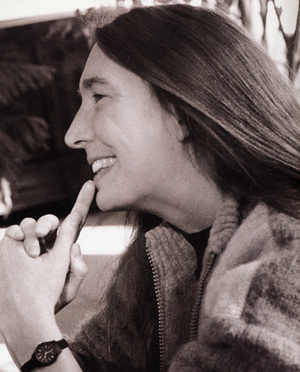
After studying drawing, painting, and printmaking first at Duke University, then at the universities of Chicago and Ohio, Jenny Holzer received a Master of Fine Arts degree from the Rhode Island School of Design. Accepted into the Whitney Museum of American Art independent study program in 1977, she moved to New York and worked as a phototypesetter at Daniel Shapiro's Old Typosopher design studio. She then gave up her abstract pictorial work, similar to that of Mark Rothko and Morris Louis, and started using language to question representation. For her first series, Truisms (1977-1979), she used advertising media or public spaces to spell out slogans in capital letters, such as "private property created crime" or "everyone's work is equally important." Influenced by American street performers, Reader’s Digest stories, minimal and conceptual art, the discoveries of female authorship, and the body art of Yvonne Rainer*, she considers herself to be an agitator. Referring back to the Russian constructivists, she ascribes an utilitarian function to art, and uses the media culture in which she is steeped to her own ends. Her second series, Inflammatory Essays (1979-1982), consists of texts inspired by political and philosophical writings (by Emma Goldman*, Lenin, Rosa Luxembourg*) printed on brightly coloured paper and wheat pasted to walls. Later, she would also carve texts on granite benches or sarcophagus, and use electroluminescence. She created memorials against racism, against the atrocities of the Second World War, and to the battle against AIDS (Laments, Dia Art Foundation, New York, 1989). In 1990, for the Venice Biennale, she exhibited a polemical work on the ambivalent ties and fears that bind mothers and their children (Mother and Child), for which she was awarded a Golden Lion. By shining a light on political and social stereotypes, she attempts to incite thought about fundamental issues, using communication methods apt to reach the largest possible public. In the 1990s, she began drawing from her personal history and the intimate relationship between body and language, moving from ideological messages and aphorisms towards meditations on the human condition. In 2009, the Guggenheim Museum in New York held a retrospective of her work.
Fabienne DUMONT
See this illustrated text on the website of the Archives of Women Artists, Research and Exhibitions