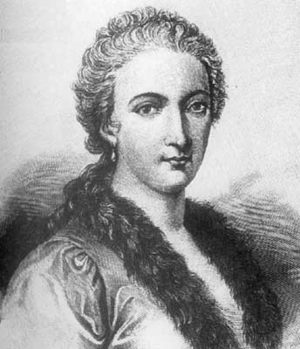
In eighteenth-century Europe, at the time of the Enlightenment, women were still denied access to higher education, except in Italy, where “girls from good families” could receive an education identical to that of boys and go to university. At that time, the University of Bologna, the oldest in the Western world, was distinguished by its number of female students and teachers. Among them, Maria Gaetana Agnesi, who was appointed to a chair of mathematics in 1750, was born into a family of the Milanese upper middle class. Her father, an arts and science lover, offered his 21 children the best tutors. She was particularly bright since, when she was very young, she mastered Latin, Greek and Hebrew as well as French, German and Spanish. She was 15 years old when her father began to invite her to his salon attended by Italian and foreign intellectuals, where she debated, usually in Latin, philosophical or scientific subjects. In 1738, she published a collection of 191 essays on philosophy and sciences, “Propositiones philosophicae”, bringing together some of the theories she had defended during these oratorical contests, including recent scientific theories, including that of Newton. She also addressed the issue of women’s education. From 1739, weary of society life, she manifested her will to dedicate herself to spiritual life and meditation, and to enter the convent. After long discussions with her father, she reached a compromise: to stay at home but live a remote life and care for her brothers and sisters, of whom she was the eldest. In 1740, Ramiro Rampinelli , monk and mathematician, became her teacher. With him, she studied Charles René Reyneau’s “Analyse démontrée” ([Demonstrated Analysis], 1707) and came into contact with Italian mathematicians of the time who worked on infinitesimal calculus, in particular Jacopo Riccati. She undertook the drafting of the “Analytical Institutions” which she submitted to the latter: thus began a fruitful correspondence, which lasted from 1745 to 1749. Pope Benedict XIV, who had studied mathematics, congratulated her personally and appointed her analysis lecturer at the University of Bologna. Appointed to the chair of mathematics at this university in 1750, she never taught there but she was the first woman to have had the opportunity. Empress Maria Theresa of Austria, to whom she had dedicated her book, rewarded her with jewels. After the death of her father in 1752, she interrupted her mathematical activities, left the family home, gave up her property and moved to the Ospedale Maggiore in Milan. In 1768, the Archbishop of Milan appointed her responsible for Christian doctrine, and at his request, in 1771, she took charge of the women’s department in a newly created charitable institution. That is where she died, in destitution.
In 1748, M. G. Agnesi published the two volumes of the “Instituzioni analitiche ad uso della gioventù italiana” (“Analytical institutions for the use of Italian youth”). This book constitutes an informed and educational summary of knowledge in a recent and rapidly developing field of mathematics. The book is characterised by its progressive structure and contains many illustrations. The first mathematical book published by a woman, it became the reference for the study of analysis and infinitesimal calculus during the second half of the eighteenth century in Europe. To make it more accessible, she wrote it in Italian, unlike her contemporaries, who still published in Latin. She used Leibniz’s language: “differential”, “infinitesimal”, still in use today, rather than Newton’s “fluxions”. The second volume was translated into French by d’Anthelmi in 1775 under the title “Traités élémentaires de calcul différentiel et integral”. The first volume ends with three curves that prepare the introduction to the infinitesimal calculus developed in the second. One of these curves, Agnesi’s cubic, became famous as the “Witch of Agnesi”, probably because of an English translation error by Colson who would have confused versiera (“turn”) with avversiera (“witch”). M. G. Agnesi became increasingly dedicated to religion and to helping the poor and sick, especially women. However, her notoriety and the solicitations continued to develop.