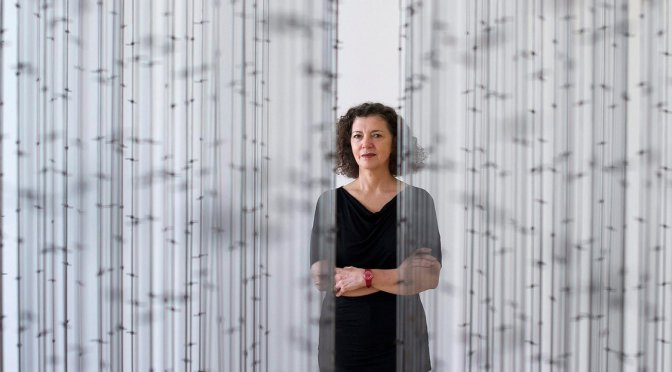
Mona Hatoum grew up in a Palestinian family of Orthodox faith, and has been living between London and Berlin since 1975. In the 1980s, she devoted herself primarily to performance and video, by seeking inspiration from the personal and political attributes of exile, from her nostalgia for her country of birth, and also from the anger and indignation resulting from the dispossession of her people: for one of her first performances, Under Siege (1982), which evokes the Lebanese civil war – the reason behind her emigration – she spent seven hours thrashing about, naked, inside a transparent polyethylene box filled with liquid mud in order to portray the suffering of her family and of the Palestinian people. She carried on this work in the Changing Parts (1983) video, which juxtaposed black and white photographs of her parent’s bathroom in Beirut with images of herself taken from Under Siege. According to art critics, this piece, which transforms a profound sense of security into feelings of danger and imprisonment, expresses the need – and also the impossibility – of going back to her home country. By the same token, the Measures of Distance (1988) video features a voice-over conversation with her mother, interrupted by the Lebanese war: simultaneously, the images of her naked body and of letters sent by her mother are superimposed, while they are also read out loud in a voice-over, evoking the pain of separation. One of her most significant video performances is Corps étranger (1994), which qualifies as body art; the film, shot with an endoscopic camera that the artist ingested, is projected onto the floor of a white circular room and expresses the manner in which the body is examined, attacked, wounded, or deconstructed. Since the late 1980s, Hatoum has focused on sculpture and installation art, in which objects from everyday life are displayed as symbols of alienation and menace. Created using organic materials (hair, bodily fluids) as well as found materials (kitchen utensils, mattresses, glass), these disturbing set pieces always display traces of dark humour and satire: thus, a vintage vegetable grater, which she enlarged 17 times, inspired The Grater Divide (2002), which looks like a folding screen. In her later work, electricity and magnetism become principles and metaphors used to illustrate the dangers lurking in every modern home or dwelling. Hatoum revisits the devices and economy used by the minimalists, in a dialog carried out with artists such as Eva Hesse* or Felix Gonzáles-Torres. From the grid in Light Sentence (1992) to Hair Grid With Knots (2006), through Cube (2006), she presents incongruous and surprising variations on the grid and the cage. For her, this architectural process, emblematic of modern art, represents confinement and violence: her Interior Landscape (2008) installation shows a room that looks like a cell filled with objects placed on and around a barbed-wire bed, on which are printed historical maps of Palestine; this creation combines two recurring themes in her work: the grid, as well as real and imaginary maps of the world (Map, 1999) or of the Middle East. The latter becomes the subject of a militant geographical practice in 3D Cities (2008) in which she added the locations of destroyed sites to city maps. For her residency at the MAL/VAL in Vitry-Sur-Seine, she created a set of 40 swings in which every seat represented the map of a capital or city from which the inhabitants and communities of the commune originated (Suspendu, 2009 – 2010). The idea of “being at home” becomes critical to her, especially starting in the 2000s. Thus, in the Homebound (2000) installation, the artist gathered many of her early works in a space invaded by objects from everyday life deprived of their primary function: a bed without a mattress, empty chairs and tables; electrical cables attached to light bulbs that only work intermittently. Disrupting the logic of expectations is one of the recurring elements in Hatoum’s work, which was recognized as a whole by a Joan-Miró award in 2011.
Nataša PETRESIN