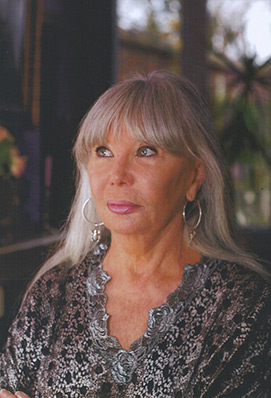
Monique Alika Watteau went to Paris to become an actress, encouraged by Orson Welles, and played in “Deux sous de violettes”, directed by Anouilh (1951). She illustrated the works of her husband, Bernard Heuvelmans, a “cryptozoologist”, and signed her first fantasy novel under the pseudonym Watteau (“La Colère végétale” [The Anger of Plants], 1954). The next three, esteemed by André Breton, express her taste for the supernatural, her fusional passion for nature, animals and monkeys: “La Nuit aux yeux de bête” ([The Night of Beastly Eyes], 1956, 2008); “L’Ange à fourrure” ([The Angel with Fur], 1958); “Je suis le ténébreux” ([I Am the Dark One], 1962). Yul Brynner gave her a gypsy nickname, Alika, under which she exhibited her first paintings (1962). Her essays, “Nous sommes deux dans l’Arche” ([There Are Two of Us in The Arc], 1975) and “Quand les singes hurleurs se tairont” ([When the Howler Monkeys Shall Be Quiet], 1976), which won the Grammont Prize, recount the rescue of monkeys undertaken with her second husband, Scott Lindbergh, the aviator’s son. An environmental activist, she collaborates to the Journal Franz Weber. Her illustrated autobiography (“Testament d’une fée” [The Story of a Fairy], 2002) and preface to a biography of her ex-father-in-law (2006) reveal some of her secrets.