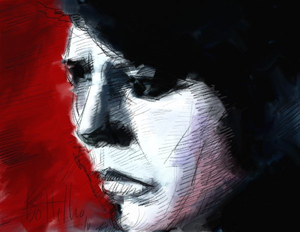
Natália de Oliveira Correia, a native of the Azores, where she lived until the age of 11, made this island the main focus of her work, a kind of maternal figure – mother-island, mother-wife, mother-country. The author has dealt with different literary genres, from poetry to essay, theatre, travel stories and memoirs. She started with children’s literature with “Grandes aventuras de um pequeno herói” (“great adventures of a little hero”, 1945) and the novel genre with “Anoiteceu no bairro” (“night-time in the neighbourhood”, 1946, reprinted in 2004), but it is through poetry that she managed to perfectly express her lyrical and ironic character (“Dimensão Encontrada” [“found dimension”], 1957). In her poems, she praises women as an archetypal matrix of erotic and passionate freedom (“Mátria”, 1968). With William C. Hyler, her second husband, she discovered the United States, and from this journey was born the essay “Descobri que era europeia, impressões de uma viagem à América” (“I discovered that I was European, impressions of travelling to America”, 1951). Having written anthologies, she was sentenced to three years’ suspended emprisonment for “Antologia de poesia portuguesa erótica e satírica” (1965). The creator of a vibrating work combining amorous and mystical lyricism, derisive satire, romantic subjectivity and realistic objectivity, she opted for the tone of indignation, away from trends, refusing to modify her work to bring it into listed literary genres. A journalist at Rádio Clube Português from 1944 onwards, she also worked with the written press and as an editor and deputy editor, which lead her to be indicted for publishing the “New Portuguese Letters” by Maria Isabel Barreno, Maria Velho da Costa and Maria Teresa Horta − a publication that revealed her rebellious personality working towards an innovative approach to the condition of women. Involved in politics and culture, she was a member of the Assembly of the Republic (1979-1991), participated in various anti-fascist opposition movements, was a consultant to the State Secretariat for Culture in 1977 and chaired the creation of the National Front for the Defence of Culture in 1992.