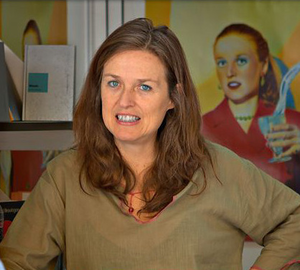
A big name in contemporary art photography, a major figure of Movida (a cultural movement created after Franco’s regime ended), Ouka Leele contributed to the renaissance of Spanish photography. After a spell at the Fotocentro in Madrid, she published her first series in black and white in 1976, and exhibited for the first time in 1978. Her work is organised into several phases: firstly, she produces stagings that she photographs in black and white; then she repaints these shots manually in colour, most often using watercolours; she then photographs the result, thus creating hybrid, burlesque, unusual images, midway between photography and painting, as testified by Peluquería (1978), possibly her most famous series, in which a succession of figures are shown with octopi, books, or fruit on their heads. In her compositions, she has her friends, loved ones, and neighbours pose, but also models, stars, or strangers. The particularity of her approach comes from her subversion of the usual function of photography – reproducing reality – using it instead as a preparatory drawing for a painting. The themes developed therefore refer to the pictorial genre: the portrait, nude, landscape, still life, and genre scene; the rules of classical painting are reappropriated in service to offbeat and frenzied compositions, exacerbated by a garish palette in precious or saturated colours, provoking extravagant comparisons and playful intermingling. This is not an isolated practice: it became a school, bringing together artists keen to show reality more faithfully than through the basic use of photography. The dreamlike and poetic aspect of her images reveals concerns with young people, eager for emancipation, provocation, and transformation of the world and to free themselves of the conventions of Franco’s Spain. In this sense, acknowledged by the National Photography Prize in 2005, O. Leele has been a leading light.
Ludovic DELALANDE
See this illustrated text on the website of the Archives of Women Artists, Research and Exhibitions