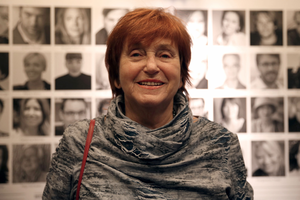
Post-war artist, Valie Export, raises the issue of sexual identity (and of her identity) in a radical way with her pseudonym and additionally, with the fact that she uses her body in her art. In 1967, borrowing from the Smart Export cigarette brand – which, like Gauloises, has strong manly connotations– she adopted this conceptual logo as a pseudonym, written entirely in capital letters. Just like other women artists, from Yōko Ono* to Niki de Saint Phalle* or Martha Rosler*, her approach fits into the framework of a gender battle. Her multidisciplinary practice (videos, performances, photographs, installations, drawings) question the conventional rules, codes, and representations of the female body, which she seeks to deconstruct. This radical emancipation, where subjectivity plays a major role, aims to condemn normative images of femininity. In that sense, she is similar to Elfriede Jelinek*, an Austrian author with whom she has collaborated. Since 1973, she has written extensively about contemporary art. During the actionist movement, she became a member of the Vienna Institute for Direct Art, founded in 1966 by Günther Brus and Otto Muehl, where she organized an exhibition on the feminist aspects of the Austrian art scene, before getting involved in the creation of the Austrian Filmmakers Cooperative. Two important differences distinguish her from Viennese actionism, to which she has often been associated: on the one hand, her refusal to engage in spectacular violence, and on the other hand, her experimental use of media to construct her identity through socially disseminated language and rituals. In 1968, she began creating cinematic experiences, which she called expanding cinema (Abstract film No 1, 1966-1967), then put on urban performances such as Tapp und Tast Kino (Tap and Touch Cinema,1968), where her own body became the subject and object of her work. These works ushered in a series of now-iconic works, including Identity Transfer (1968), Body Sign Action (1970), and Body Configurations (1972-1976), conceptual photos or videos of performances in which the artist used her body to make alienation visible and become a "means to explore social reality." In the 1970s, this artistic approach linked her practice to that of body art. In 1969, a famous performance took place in a porn movie theatre in Munich, which is where the Aktionhose: Genitalpanik (Action Pants: Genital Panic) posters came from. Moving away from a feminist actionism, Valie Export developed a shape-shifting body of work, often conceptual, whose militant nature would soften in her later work. Starting in the 1990s, she pursued a somewhat less radical art, using videos and experimental interactive installations. What consist of "video sculpture" or video installations deconstruct, on the one hand, the language specific to this medium and to photography, and, on the other, the concepts of author and of identity. She thus examined the notion of pathos by applying psychological qualities to expressive body postures. In a performance simultaneously retransmitted on a video screen (The Pain of Utopia, 2007), she submitted her glottis and vocal cords to an internal camera inspection, while she struggled to deliver a speech on breath and voice, as an exploration of the strong links between body and language. More recently, her work has been tied to international politics, particularly since the Iraq war; Kalashnikov (2007) is a piece that can be considered to be critical of the status of increasingly violent images circulating on the Internet. Valie Export has been exhibited, namely at the Moscow and Venice Biennales (2007), as well as the Belvedere in Vienna (Time and Countertime, 2010).
Chantal BÉRET